
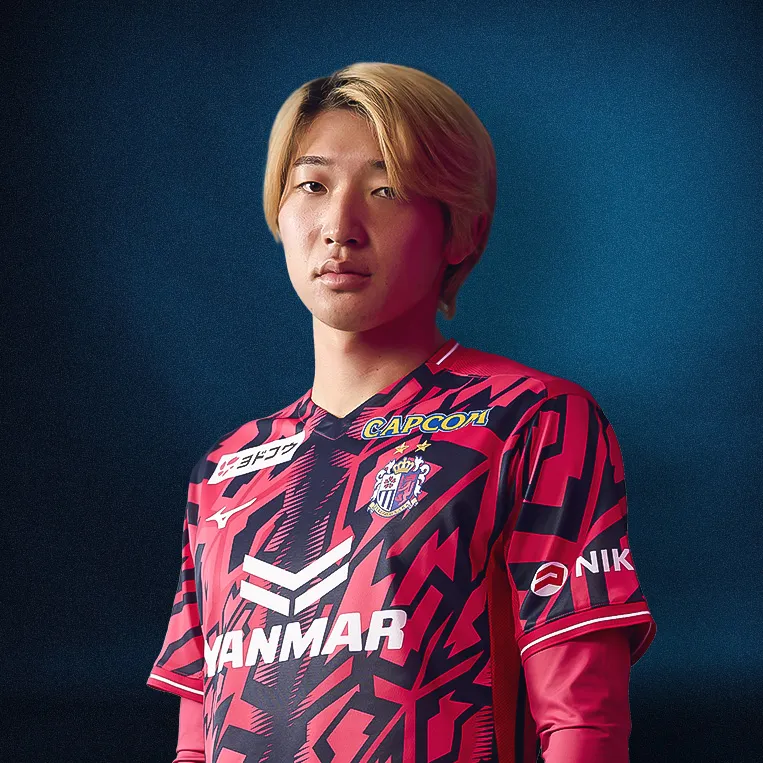
MY VIEW · RECRUITMENT ASSESSMENT
A clear weapon. Still building the complete attacker.
Progress to full-match scouting for a left-sided attacker who can also receive in the inside channel. The carrying profile is worth pursuing. Id want better evidence of the final pass, shot selection and defensive reliability before paying for a ready-made European starter. Give him a role that produces good one-against-one situations, then judge whether the move ends with an advantage for the team.
BACKGROUND & DEVELOPMENT
A football family. A route he still had to earn.
His father Hirotoshi Yokoyama is a former professional player and coach; older brother Ayumu is also a professional. In Imabari’s own interview, Yumeki explained why playing mattered more than going straight to a J1 club. Watching his brother progress from J3 helped shape that thinking. A familiar surname did not remove the need to find minutes. [05]
His club route was FC Tokkano U12 and U15, then Teikyo High School. Imabari announced his planned 2024 arrival alongside Teikyo teammate Rei Umeki in March 2023. JFA approved his special-designated registration that April, allowing him to remain registered at school while being eligible for the professional club. [01][07]
The school record is worth treating properly. JFA records his 83rd-minute goal in Teikyo’s 2-2 draw with Tokyo Verdy Youth in June 2023; he also scored against Mitsubishi Yowa that September. Those are useful examples of his school-level scoring contribution; a complete season total was not verified. [08][09]
There was positional variety early on. Takahito Ando’s 2023 interview described a school striker who impressed Imabari from central midfield during his trial, enjoying the extra touches and chances to turn. That helps explain the comfort receiving inside. It does not make him a sensible defensive midfielder for a buying club now. [06]
School football to three senior levels.
- 2013–20FC TokkanoU12 → U15
- 2021–23TeikyoSchool football
- 2024–25FC ImabariJ3 → J2
- 2026–Cerezo OsakaSpecial → J1
Career dates from the official registration history. A progression chart, not a claim of automatic improvement. [02][03]
| Competition | Apps | Starts | Min | G | A | Shots |
|---|---|---|---|---|---|---|
| 2024 · Imabari · J3 | 29 | 23 | 1,555 | 6 | 5 | 52 |
| 2025 · Imabari · J2 | 25 | 14 | 1,423 | 6 | 6 | 69 |
| 2026 special · Cerezo | 18 | 9 | 826 | 4 | 1 | 25 |
| 2026/27 · through 17 Oct | 9 | 6 | 473 | 1 | 0 | 14 |
J3 and J2 output is not treated as equivalent to J1. Cups excluded. [10][02]
Same player. Different jobs and opposition.
Calculated per 90 · each competition kept separate
Shared 0–5 scale. Minutes include substitute appearances. Per 90 is a descriptive rate, not a forecast or adjustment for league strength. [10][02]
ROLE & BALL CARRYING
Start him on the left. Give the dribble somewhere to go.
My first role would be left wing, with freedom to receive in the left inside channel. A runner can occupy the centre-back while an overlapping full-back makes the outside route credible. Id want the defender choosing between two problems, rather than Yokoyama repeatedly receiving against a settled double team.
JFA’s Asian Games feature described him coming on at left wing against Hong Kong and repeatedly getting beyond defenders. It also reported his work on running mechanics and mobility with Satoru Tanigawa, introduced through Shinji Kagawa. There is a specific development process here, not just a vague hope that he gets quicker. [14]
The next action is my main test. Once the first defender commits, can he release the overlapping player, find the cutback or get a better shot instead of taking on another opponent? Id code the sequence through to its outcome, including possessions where he should pass early. A successful take-on can still leave the team in a worse position.
A left-sided threat with two exits.
My proposed use, not an observed positional map. The full-back and striker movements show the support id want around him.
UNDERLYING DATA
The carrying survives. The end product needs more work.
In the matched Football LAB panels, dribbling contribution works out at 1.36 points per 90 in 2025 J2 and 1.57 in the 459-minute J1 sample. Id take that as a reason to keep watching. It is not a league-adjusted improvement score, and these are model points rather than completed dribbles. [11][12]
The shot picture is less comfortable. His full 2025 J2 season produced 69 shots in 1,423 minutes, or 4.36 per 90. The current nine-game J1 log has 14 in 473, or 2.66. Opportunity, role and opposition have changed. The question is whether he can create better chances without needing the old volume. [10][02]
Football LAB gives his 2025 season 4.845 xG against six actual goals. The Cerezo snapshot gives him 0.738 xG against one. His J2 attempts averaged about 0.070 xG per shot. For me, getting into better shooting positions matters more than treating six goals from that volume as proof of elite finishing. [11][12]
Six J2 assists were useful output. The current official widget records none, but I would not turn that into a claim that he creates nothing: assists depend on the next player finishing too. Current xA, take-on attempts, success rate, progressive carries and possession-adjusted defensive events were not verified, so none is presented as measured fact here. [10][02]
Most of the attacking contribution comes from dribbling.
Football LAB attacking contribution split · model points
A share of model attacking points, not possession, touches or success rate. J2: 1,423 min. J1 contribution panel: 459 min through 10 Oct. [11][12]
See all nine underlying contribution categories
| Category | 2025 J2 total | J2 / 90 | J1 panel total | J1 / 90 |
|---|---|---|---|---|
| Attack | 42.47 | 2.69 | 14.43 | 2.83 |
| Passing | 11.57 | 0.73 | 4.26 | 0.84 |
| Crossing | 9.43 | 0.60 | 2.14 | 0.42 |
| Dribbling | 21.47 | 1.36 | 8.03 | 1.57 |
| Receiving | 22.65 | 1.43 | 6.48 | 1.27 |
| Shooting | 49.67 | 3.14 | 7.19 | 1.41 |
| Goal | 22.83 | 1.44 | 4.08 | 0.80 |
| Ball winning | 78.26 | 4.95 | 6.43 | 1.26 |
| Defending | 4.29 | 0.27 | 0.52 | 0.10 |
Per 90 = model points × 90 ÷ minutes. Different categories have different scales. Receiving, shooting, goal, ball winning and defending are not parts of the attack split above. [11][12]
Goals ahead of xG. Small samples, not a finishing guarantee.
Bar = xG; pink marker = actual goals. Shared 0–7 scale. The current xG snapshot is kept separate from the later 473-minute appearance total; no current xG/90 is calculated. [11][12]
15 MODEL DESCRIPTORS · 19 OCT SNAPSHOT
The standout is clear. The scale needs context.
Football LAB’s Playing Style values are derived 1–20 descriptors, not my scouting grades or success percentages. A 20 for dribble opportunity does not mean he wins every duel. [13]
THE OTHER HALF OF THE JOB
The dribble must earn him a full-match role.
In Imabari’s May 2024 interview, he was direct about his difficult debut: he came on and was taken off again, with defensive understanding and awareness part of the problem. He spoke about learning to judge the pressing approach himself instead of relying entirely on instructions from behind. That is dated self-assessment, not proof that the same problem remains unchanged. [05]
The current league log shows six starts in nine appearances, with no full 90. My concern is not a guessed fitness diagnosis. It is whether he can give a coach enough away from the ball to stay on when the game is difficult: close the passing lane, help the full-back and react after losing possession. [02]
The low defensive model indices are a prompt to investigate those phases, not a substitute for watching them. Id separate pressing effort from pressing judgment, and defensive opportunity from execution. An attacker high up the pitch should not be compared with a holding midfielder as if they had the same job.
Six starts. No full 90 in the retrieved league log.
Pink = start · green = substitute appearance · 0–90 minutes
Nine appearances, 473 minutes through 17 Oct. The log does not explain substitutions or the absence of later entries. [02]
JAPAN YOUTH CAREER
A tournament contributor, not just a name on a squad list.
JFA’s February 2023 U18 candidate-camp list includes him while at Teikyo. By September 2024 he was selected for Japan U19’s U20 Asian Cup qualifying campaign. Those are two distinct steps; a candidate camp is not an international cap, and I have not supplied a guessed career caps total. [15][16]
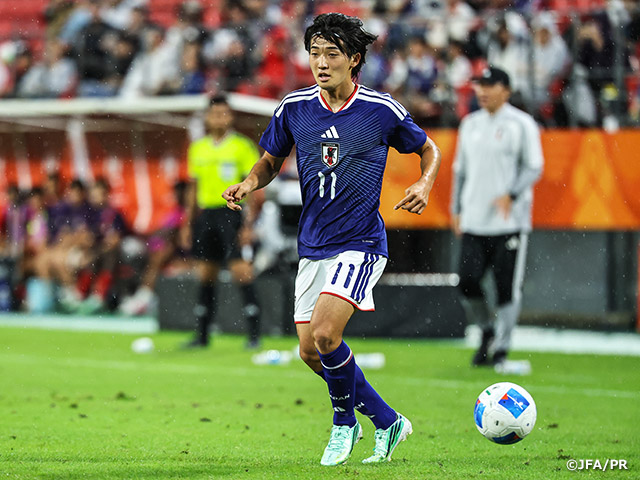
His 2025 U20 World Cup had four appearances, one start and one goal. The Chile moment is a good example of impact from the bench: introduced at 79 minutes, he scored at 82 in a 2-0 win. He later started against New Zealand and came on against France in the round of 16. The complete match sample is below. [17][18][19][20]
He then started Japan’s 4-0 win over China in the January 2026 U23 Asian Cup final, playing 78 minutes. At the October Asian Games he started the final against South Korea and was not substituted in the 1-0 defeat. Those are useful pressure-game reference points for the next film review, rather than a reason to assume a senior national-team place is inevitable. [21][22]
I like that the route contains different kinds of selection: first camps, substitute impact and later final starts. The development is more informative than a single highlight. It still needs testing against established senior defenders over a sustained run of club matches.
| Venue date | Opponent / result | Start | Min | G | Detail | Source |
|---|---|---|---|---|---|---|
| 27 Sep 2025 | Egypt · 2-0 | No | 24 | 0 | On at 66 | [17] |
| 30 Sep 2025 | Chile · 2-0 | No | 11 | 1 | On at 79; scored at 82 | [18] |
| 3 Oct 2025 | New Zealand · 3-0 | Yes | 58 | 0 | Off at 58 | [19] |
| 8 Oct 2025 | France · 0-1 aet | No | 47 | 0 | On at 73; 120-minute match | [20] |
All four Japan matches. Minutes calculated from substitutions, excluding added time; France includes extra time. Venue dates are used consistently, so may differ from Japan-time reporting.
- 2023
U18 candidate camp
A first verified national pathway checkpoint. [15]
- 2024
U19 qualifying squad
U20 Asian Cup qualifying in Kyrgyzstan. [16]
- 2025
U20 World Cup
Four appearances and a goal against hosts Chile. [18]
- Jan 2026
U23 Asian Cup final
Started, 78 minutes; 4-0 win over China. [21]
- Oct 2026
U21 Asian Games final
Started, full match; 0-1 against South Korea. [22]
AGE, UPSIDE & NEXT STEP
Twenty-one, with a clear weapon to develop.
Born on 23 September 2005, he turned 21 last month. He has already experienced two steps up in senior competition. The attraction is the room to turn an obvious carrying strength into more complete attacking output, rather than expecting him to develop an entirely new way of hurting opponents. [02][03]
My upside case is a first-team winger in a stronger European environment who can change the shape of a defence, then make the pass or finish count. The more modest useful outcome is a J1 starter or high-impact rotation attacker. The downside is a player whose carries look exciting but whose final decisions and defensive contribution keep limiting his minutes.
Id first investigate Belgian or Dutch clubs with a genuine wide role and patient individual coaching. That is a scouting-market preference, not reported interest or a claim that either league is easy. A team that needs a touchline winger is a different fit from one buying a central creator. I have not verified an active overseas bid, fee, contract expiry or release clause.
Staying at Cerezo is a credible option if the next move offers little more than a bench place. Id want a complete cost and minutes plan, with an initial commitment that works for the useful outcome. Add-ons can reward progress. A future big sale should not be the only thing that makes the deal look sensible.
DATED MEDICAL CONTEXT
The shoulder history needs a proper check.
In his August 2026 club interview, Yokoyama recalled a shoulder dislocation during his Imabari period, surgery after the 2024 season for recurrent right-shoulder dislocation and the rehabilitation that delayed his 2025 start. That is his retrospective account. It is not a current injury announcement. [04]
For recruitment id ask clinicians to review the original records, current stability and contact exposure. Public appearances do not provide medical clearance, but the old surgery alone does not establish a current problem either. I cannot put a recurrence percentage on it from the available evidence.
WHAT ID WATCH NEXT
Four things that would move the decision.
After the take-on
Track the next two actions, including failed carries and early-pass opportunities. Does the team reach a better chance?
Without space
Review deep blocks and tight marking, not only open transitions. Look for combinations when the dribble is closed.
Without the ball
Check pressing angles, the full-back partnership, runner tracking and reactions after turnovers.
Across a full game
Separate starting and substitute impact, then test repeatability through longer appearances and stronger contact.
METHOD & LIMITS
What this report establishes.
Desk-based analysis of official records, original Japanese interviews and Football LAB. Full-match film and live scouting have not been completed for this report. Role diagrams and recruitment judgments are explicitly my projections. Photos identify the player; they are not evidence of a measured tactical pattern.
The dated J.League extract ends on 17 October, even though research was checked on 22 October. The player contribution panel has 459 minutes through 10 October; its totals are not combined with the later 473-minute log. Cached Football LAB versions can differ. The published xG snapshot is not assigned an unverified player-minute denominator. The 2026 special competition is separate from the August-start league.
Complete school-season totals, a full career youth-cap count, xA, dribble success rate, progressive carries, medical clearance and transfer terms remain unverified. A candidate camp, a squad selection and an appearance are distinct. Historical shoulder evidence is not presented as a current injury. No active overseas bid is claimed.